
different types of wave propagation

(a) Ground wave propagation:
The type of propagation in which radio waves propagate from transmitting antenna to receiving antenna following the surface of the earth is called ground wave propagation.
Electromagnetic waves which are vertically polarised can travel by this mode.
The intensity at the signal falls with the distance as radiowaves induce current in the ground over which they pass. As the wave propagate, the corresponding angle of tilt goes on increasing after a certain time the wave dies out.
Frequency at which ground waves travel is upto 1500 KHZ.
c = f.λ
wavelength, λ = 200m
Used for local broadcasting, ship communication etc.
b) Sky wave propagation:
The propagation of Radiowaves from tranmitting antenna to receiving antenna via reflection from the ionosphere is called sky wave propagation.
The ionosphere region consists of ions which extends from a height of 60km to 300 km.
As we go higher in the ionosphere, there is an increase in the free electron density consequently there is decrease in the Refractive Index (μ).
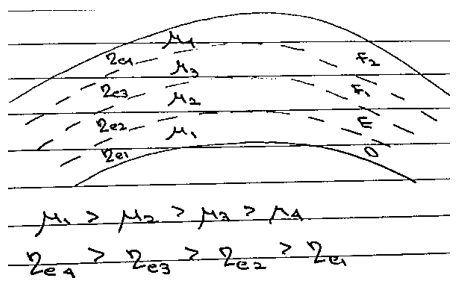
Thus, as radiowave travel up in the ionosphere it travels from denser medium to rarer medium. It continuously bends from its path till it suffers total internal reflection to reach back to the Earth.
c) Space wave propogation:
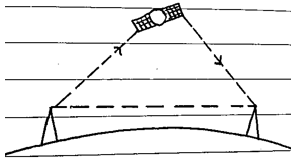
Space wave propagation can be achieved in the following 2 ways:
1) LOS Communication
2) Satellite Communication
Consider a TV antenna OP of height h. The transmitted signal cannot be received beyond points  and 
OR1 and OR2 are maximum distance from the antenna.
let OR1=OR2=d
from PCR1

Comments

Post a Comment

Popular posts from this blog

Application Engineer- Prototyping at Siemens India

  Hello, Dear Readers, Siemens India has a vacancy for the Application Engineer role. Siemens EDA is a global technology leader in Electronic Design Automation software. Our software tools enable companies around the world to develop highly innovative electronic products faster and more cost-effectively. Our customers use our tools to push the boundaries of technology and physics to deliver better products in the increasingly complex world of chip, board, and system design. This role is based in Bengaluru. But you’ll also get to visit other locations in India and globe, so you’ll need to go where this job takes you. In return, you’ll get the chance to work with teams impacting entire cities, countries, and the shape of things to come We make real what matters! This is your role: Deploy Siemens EDA ProFPGA prototyping software and hardware solutions at customers and guide the customers to successful design bring-up Work closely with R&D to solve problems, review product spe...

Tutorial on EasyEDA desktop software for PCB and schematic design

In this article, I am going to write a tutorial on how to use EasyEDA desktop application for creating a schematic and for PCB design. One of best advantage of this software is that you can create design offline and can automatically synchronize your design with your online EasyEDA account.  It can be used for circuits simulation, PCB deign and electronics circuits design. You can download EasyEDA desktop application by clicking on following link and it will work on windows 7 or its greater version. They are also releasing soon offline application OSX and Linux users. So keep visiting their website for more information.                                                    https://easyeda.com/page/download So let’s start and see how to design a schematic and PCB using EasyEDA offline desktop application. So first of all lets see how to create a schema...

CMOS OPAMP Design Using LTspice

  Hello Dear Reader, Here in this post, I will give an idea about how CMOS OPAMP designing using 180nm technology node and using LTspice. from that opamp I have design switched capacitor integrator. Design Specifications: Here Design specification may be changed according to the application here my target is to design an active lowpass filter so I have chosen an opamp integrator so in the below I have explained how to design an opamp as well as an integrator in a 180nm technology node in LTspice. So let's start design First, we need a technology parameter file so that the file we can insert in the LTspice, in my example it is 180nm so mostly it is available from the  http://ptm.asu.edu/latest.html  and you make one text file using notepad or whatever is fit on your own. Then go to the LTspice and new schematic and then you see .op on the right most upper side click on it and give your text file path after .include  as shown in the below images.  Now first of all...